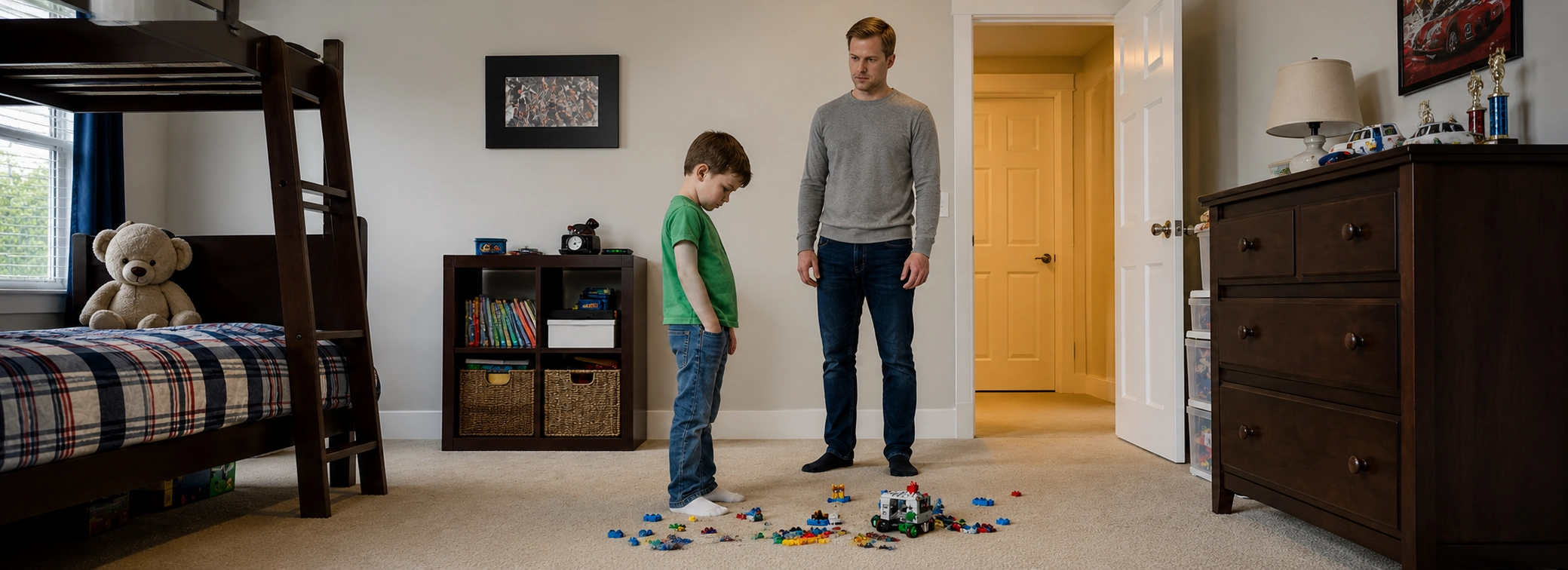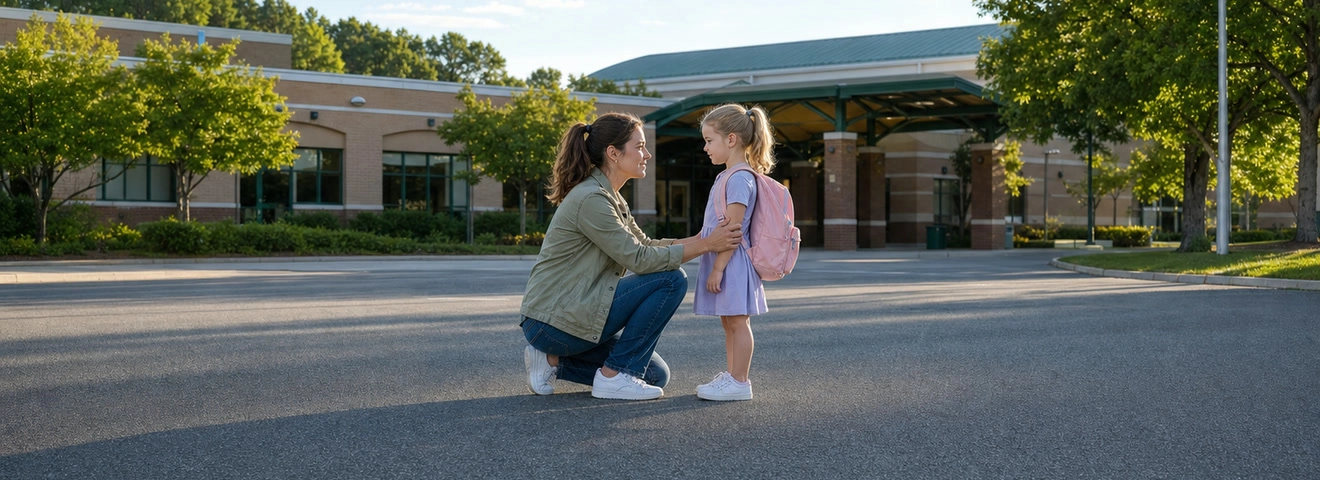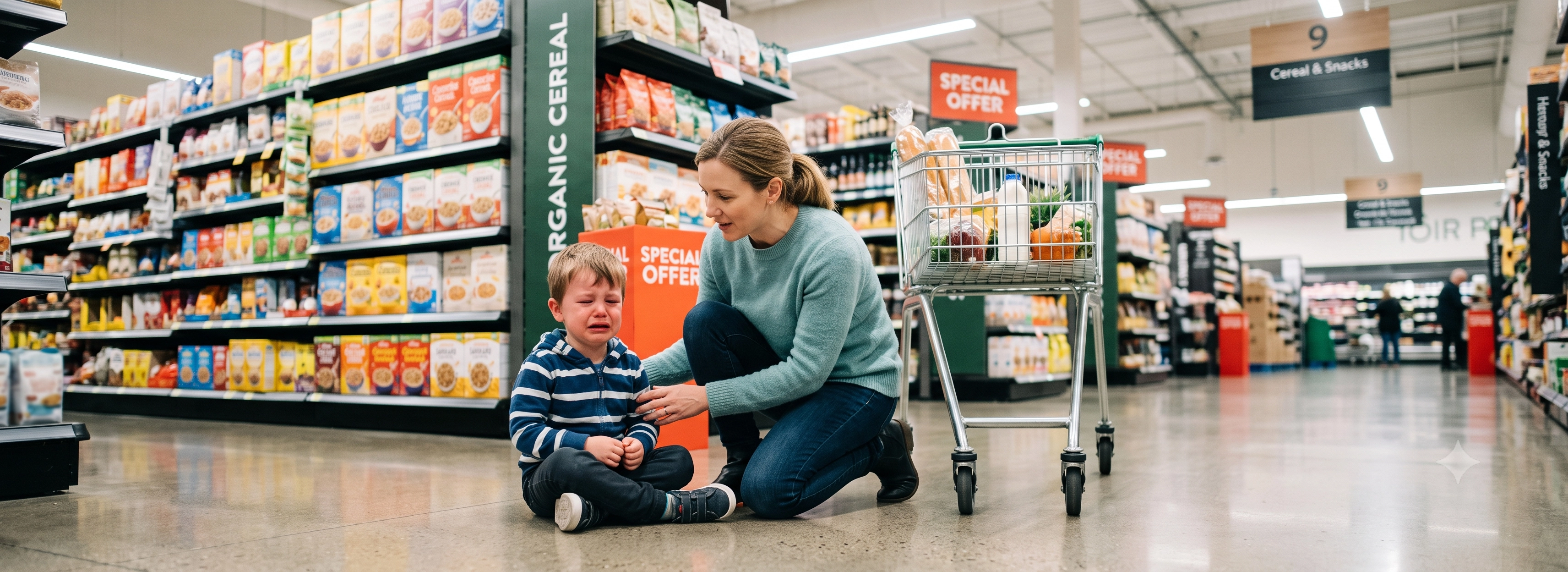
The grocery store is not a neutral place for a young kid’s nervous system, it is a pileup of nearly every meltdown trigger at once: bright lights and noise, shelves full of things they want but can’t have, a route they don’t control, and often the tail end of a long day. The meltdown is not a plan to embarrass you. It is a nervous system that has run out of room. The most powerful fix is timing: shop when your kid is fed and rested, keep the trip short, and give them a job, holding the list, finding three things. And when a meltdown does hit, your calm, not the audience’s opinion, is what ends it fastest.
Every parent of a young kid knows the scene. The trip that was supposed to take twenty minutes. The kid who was completely fine ten minutes ago. The aisle where it all comes apart. And the special sting of it happening in public, the other shoppers, the looks you imagine, your own calm slipping right alongside your kid’s.
The grocery-store meltdown is one of the most common and most predictable meltdown events in early childhood. Understanding why it is so predictable is the first step to making it less inevitable.
What makes the grocery store so hard
A grocery store gathers, in one place, an unusual concentration of the exact conditions that overwhelm young kids. Any one of them would be manageable. Together, they create a demand that often exceeds the coping ability of kids aged about two to seven, and they all hit at once.
The sensory load a store puts on a young nervous system
Bright fluorescent lights, competing sounds, strong and changing smells, and busy visual clutter in every direction, a grocery store is far more demanding on the senses than almost any room a kid spends time in. For kids who are naturally more sensitive, the load starts the moment they walk in and only builds. Some kids simply take in and react to all of that input more strongly, which makes a packed environment much harder to handle.
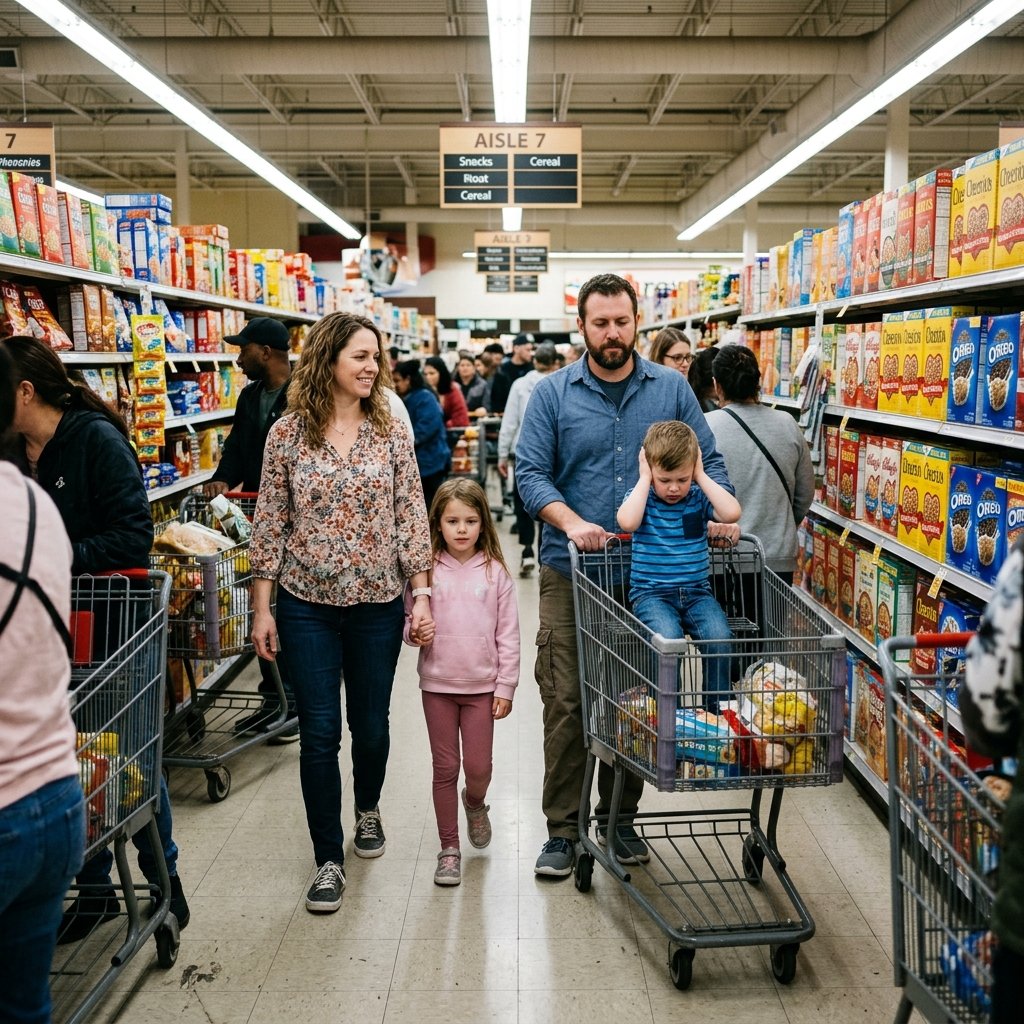 Bright lights, competing sounds, and visual clutter, the sensory load starts the moment they walk in.
The wanting-and-waiting cycle
The store is built, on purpose, to create wanting. Colorful packaging sits at kid eye level. Familiar characters smile from boxes. The things your kid has seen advertised are right there. So your kid is in a near-constant loop of wanting things and being told no, and each small no adds to the load.
On top of that, your kid has to follow, wait, and hold back for the entire visit. They did not choose to be there. They cannot pick the route, set the pace, or decide when it ends. Waiting, following, and restraining all draw on self-control, and in young kids that brake is still being built, so “behaving” in a store costs them far more effort than it costs an adult.
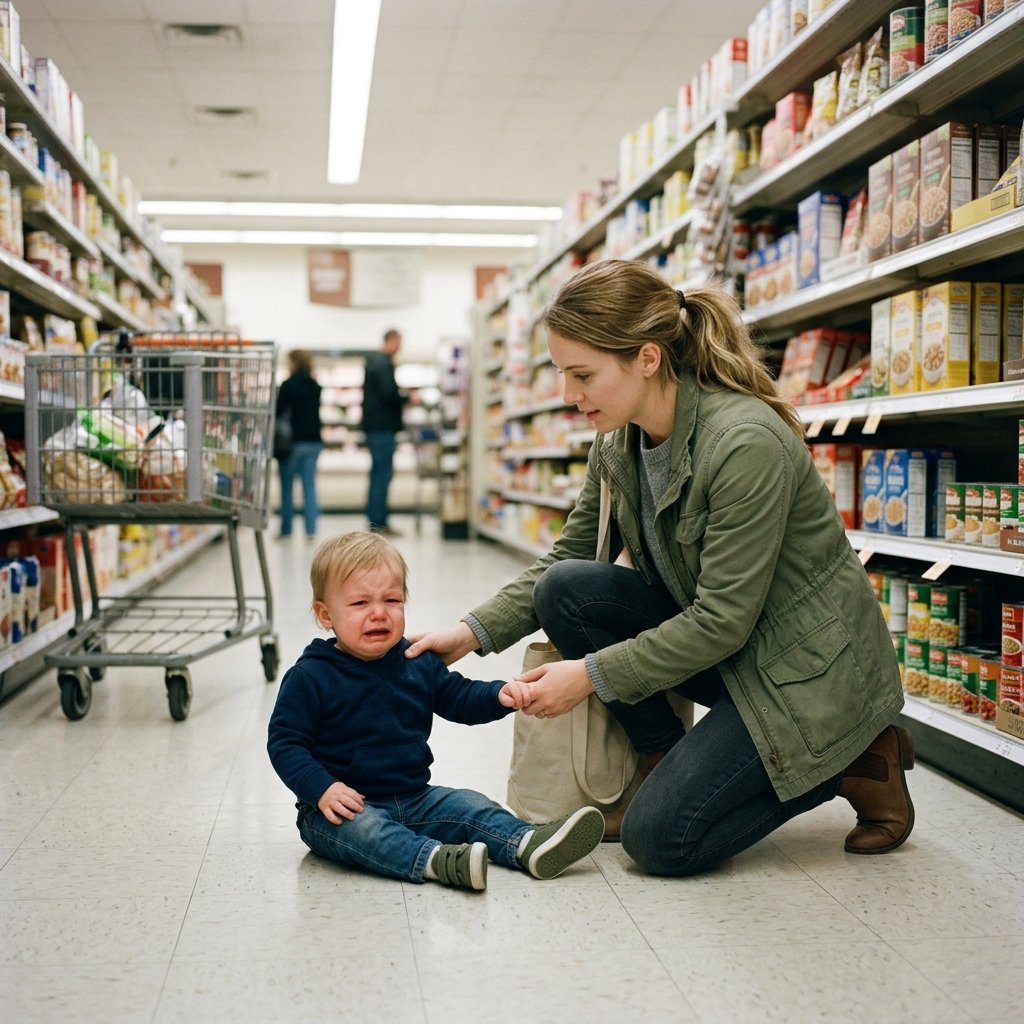 Wanting things and being told no, again and again, each small no adds to the load.
Why timing changes everything
Timing is the single most powerful lever you have. The same trip is a completely different experience depending on when it happens. A store run when your kid is rested and fed, in the morning rather than late afternoon, early in the week rather than at the depleted end of it, produces far fewer meltdowns than the identical trip taken when your kid is running on empty. If you have any control over when you shop, that is where to use it.
A MOMENT YOU MIGHT RECOGNIZE
It’s 5:40 p.m. You stopped for ten things on the way home. Your kid skipped their nap, the store is bright and loud, and you’ve already said no to the cereal with the cartoon on the box, the candy by the register, and the balloon. By aisle six, they’re on the floor. From the outside, it looks like a tantrum over a cookie. From inside their nervous system, the cookie was just the last thing on top of a load that was already too heavy.
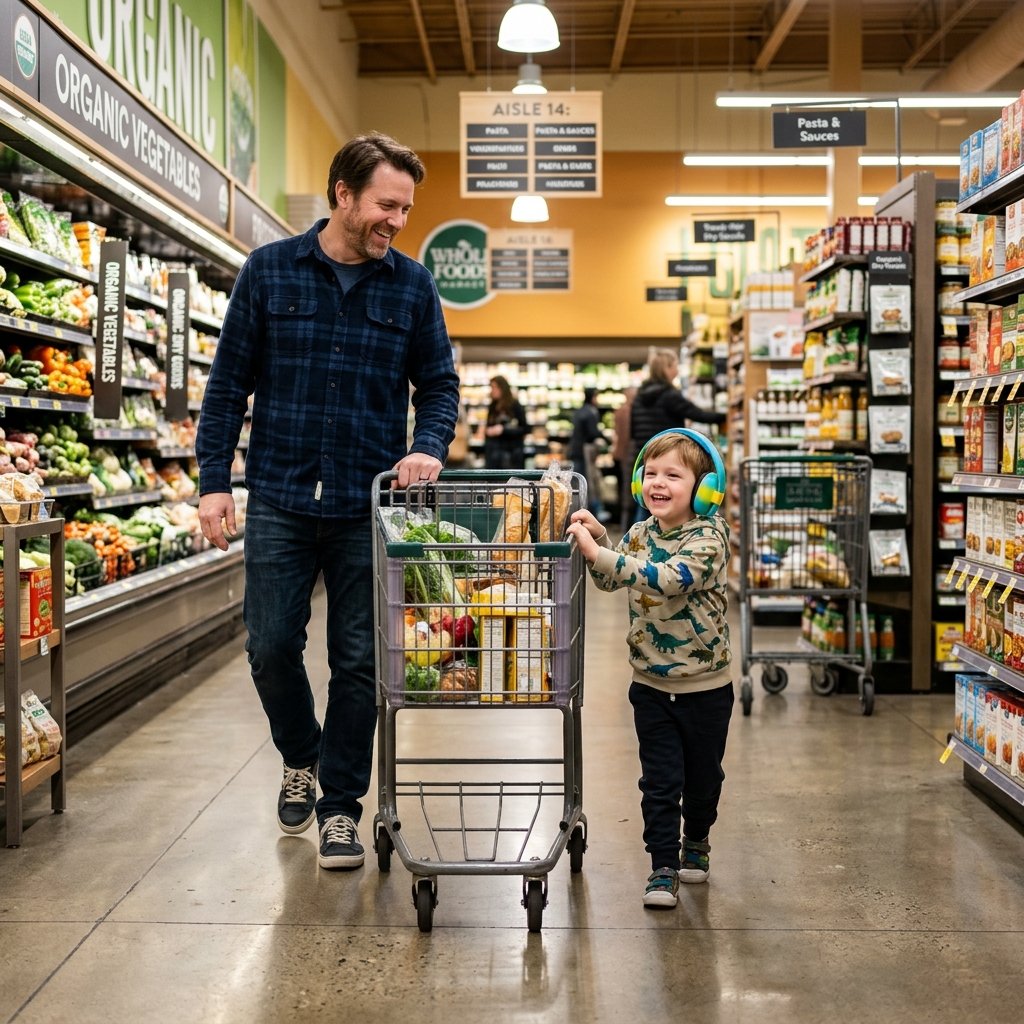 From the outside it looks like a tantrum over a cookie. From inside, the load was already too heavy.
Help Shape the Future of Active Learning
Join our exclusive Founding Member program. Get early access to new interactive modules, direct input into our product roadmap, and lifetime pricing options.
Why an audience makes it harder for both of you
A public meltdown is harder to manage than a private one, for reasons worth understanding. For you, the watching eyes switch on a kind of social anxiety. You are trying to help your kid settle while also managing your own discomfort at being watched. That split attention makes you a less steady presence, and a steady presence is exactly what your kid needs to borrow.
For your kid, your stress is visible and contagious. A kid whose parent has become tense and embarrassed has a harder time coming back down, because the one resource they most need, your calm, is now less available.
“A public meltdown is harder to manage than a private one for one simple reason: the audience makes the parent less calm, and a less calm parent is a less steadying presence for the kid.”
What to do before, during, and after
Before
Shop at a good time when you can. Then set expectations: “We’re going to the store. We’ll get these things, and then we’ll leave. You can hold the list if you want.” A kid who knows what to expect walks in with less anxiety and more room to cope.
During
Give your kid a job, holding the list, putting items in the cart, being the one who finds the bananas. A job turns your kid from a passenger who has to wait and follow into a participant with a role, and being involved costs far less self-control than sitting still and complying. Then move quickly: a focused twenty-minute trip is consistently easier than a forty-minute browse.
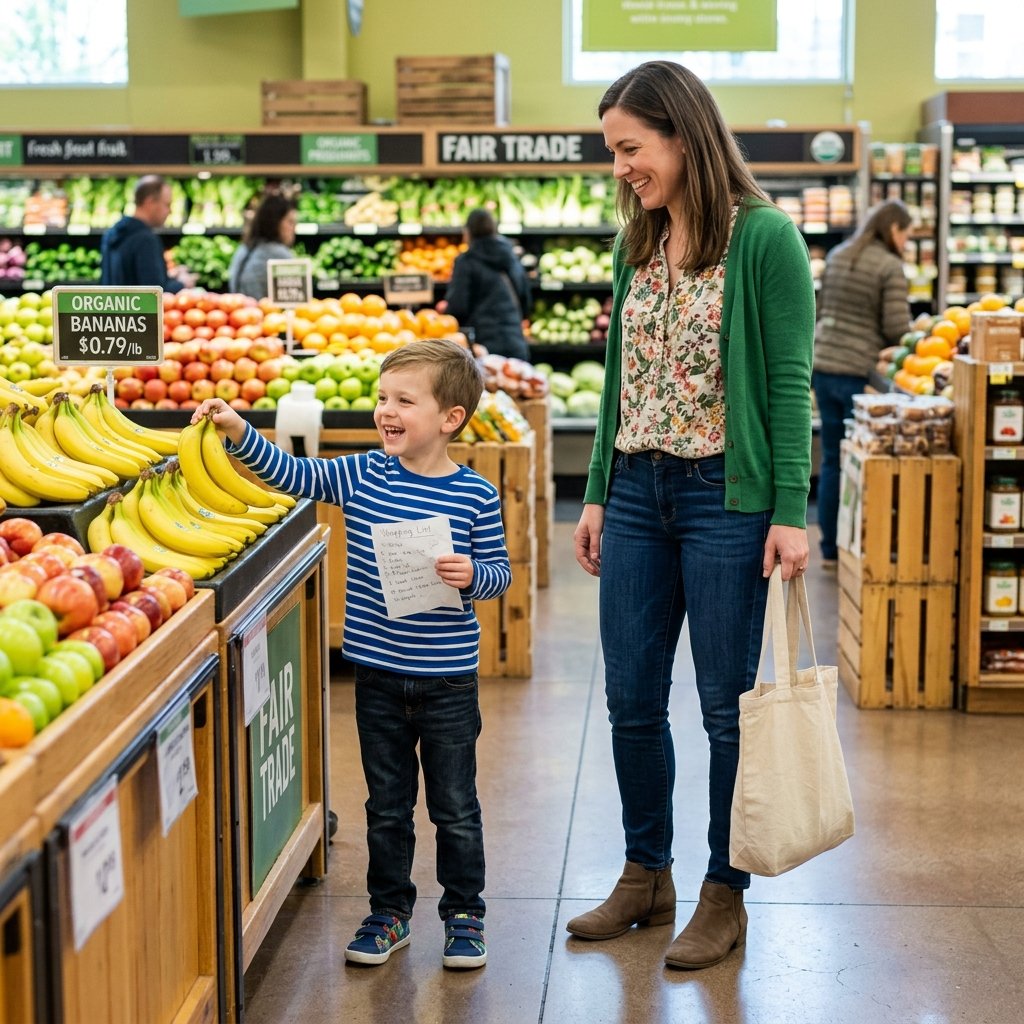 A job turns your kid from a passenger into a participant, involvement costs far less self-control than sitting still.
After
If a meltdown happens, the response is the same as anywhere: stay calm, keep your words few, and let it pass. The embarrassment is yours, not your kid’s, and it is worth making sure your response is shaped by your kid’s needs, not by the audience.
When the right call is simply not to go
Sometimes the best choice is not to bring your kid at all. A kid who is sick, overtired, or in the middle of a hard stretch is a kid for whom the store will almost certainly produce a meltdown. Choosing to go alone, or at a different time, is not avoiding a lesson. It is reading your kid accurately and meeting them where they are. The meltdown-free trip is not a missed opportunity, it is a reasonable accommodation.
When grocery-store meltdowns are worth a closer look
Meltdowns in stores are normal, even when they are intense and frequent, and they usually ease between ages five and eight as self-control grows. Still, it is worth a chat with your pediatrician or a child psychologist if meltdowns are getting more frequent or intense with age rather than less, if your kid seems unusually overwhelmed by everyday sights and sounds across many settings, if recovery routinely takes a very long time, or if your instinct says something is off. Early input brings support and peace of mind.
Is Your Kid's Screen Time Active or Passive?
Most screens capture a kid's attention without checking their understanding. Take our 2-minute diagnostic quiz to evaluate your kid's digital patterns, identify autoplay traps, and receive actionable insights to maximize active learning.
Start Screen Time & AI QuizFOR PARENTS
Activity Games on Aiino build the self-control that makes hard places easier.
Waiting, following directions, and holding back all draw on the brain’s control center. Aiino’s Activity Games build working memory and impulse control through play, strengthening the very skills that make demanding places like the grocery store less costly over time. Built for ages 3 to 9. Zero ads. Zero tracking.
Research Citations
- [1]Highly sensitive kids take in and react to sights, sounds, and textures more strongly, which makes a packed sensory environment far more demanding to manage (Lionetti et al., Frontiers in Psychology, 2024). Frontiers in Psychology. View source →
- [2]The self-control needed to wait, follow, and hold back keeps developing across the preschool years, so sustained good behavior in a store costs young kids far more effort than it costs adults (Geeraerts et al., Kid Development, 2021). Kid Development. View source →
- [3]A calm adult is the resource an overwhelmed kid borrows to settle, which is exactly why a stressed, embarrassed parent finds a public meltdown harder to calm (Lobo & Lunkenheimer, Developmental Psychology, 2020). Developmental Psychology. View source →