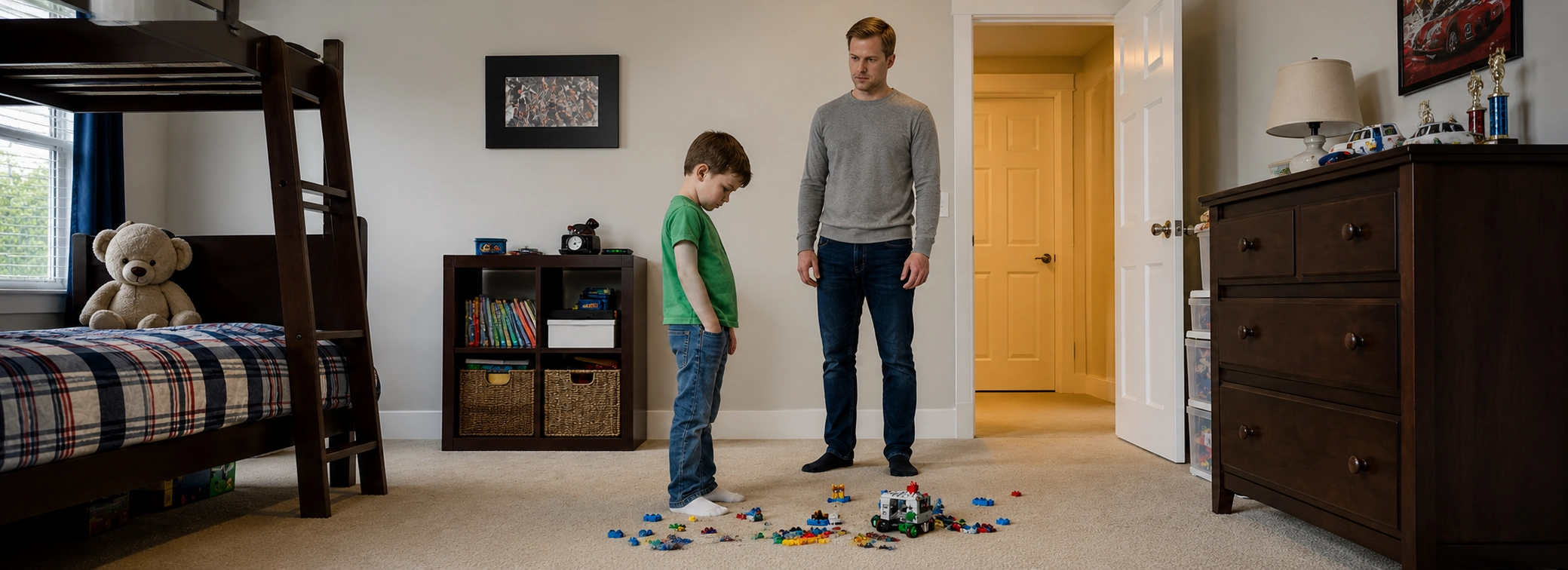
Most hard behavior in kids aged three to nine is a phase — it is developmental, it is temporary, and it fades with time, patience, and support. A behavior is more likely to need attention when it lasts well past the age you’d expect, is much more intense than other kids the same age, shows up alongside several other worries at once, or gets in the way of your kid’s friendships, learning, or family life. And if your gut keeps telling you something is off, that is worth listening to. The most useful question is not “is this normal?” — it is “what does this behavior need in order to get better: time, support, or a professional’s input?”
The question shows up in different forms. “Is this normal?” “Will they grow out of it?” “Should I be worried?” “At what point do I stop waiting and actually do something?” Underneath all of them is one question: is what is happening with my kid a phase that will pass with time and support — or is it something that needs more than time to resolve?
It is one of the most important questions in kid development, and it does not have a simple answer. But it has a useful one.
What “just a phase” actually means
“Just a phase” is accurate when a behavior comes from a developmental stage your kid is genuinely in, matches what you’d expect at that stage, eases as they grow through it, and does not seriously get in the way of daily life along the way.
Real phases are well documented. The explosive frustration of a two-year-old discovering they have their own will. The limit-testing of a four-year-old mapping out how relationships work. The comparing and competing of a seven-year-old who has just realized that performance can be measured against others. These are true phases — predictable stages most kids pass through, that serve a purpose, and that fade.
 The limit-testing of a four-year-old mapping out how relationships work is a well-documented phase.
“Just a phase” is not the right label when the behavior is much more intense than you’d expect, lasts well beyond the usual window, comes with other worries at the same time, or is seriously disrupting your kid’s life and your family’s.
A MOMENT YOU MIGHT RECOGNIZE
Two five-year-olds both melt down at drop-off. One settles within minutes, has friends waiting inside, and is happily building blocks by the time you peek through the window. The other cannot be comforted, has started refusing to go at all, and has stopped playing with the kids he used to love. Same behavior on the surface. Completely different story underneath. The difference is not the meltdown — it is whether it is getting in the way of his life.
The typical age windows for common hard behaviors
Meltdowns and explosive reactions are typical from about age two to five and drop off noticeably by six or seven as the thinking brain matures. Frequent, intense meltdowns well past seven are worth a closer look.
Hitting, biting, and pushing are typical from about two to four and fade significantly by five. Physical aggression toward other kids that continues past five or six deserves attention. Strong separation anxiety is normal in waves from infancy through about age four; when it is still seriously disrupting school or daily life past five, it is worth professional input. And early “lying” — the creative, in-the-moment kind — starts around three and is normal in early childhood, while frequent, elaborate, or anxiety-driven lying in older kids is a different pattern.
 Frequent, intense meltdowns well past seven are worth a closer look, as they typically drop off as the thinking brain matures.
The signs a behavior is more than a phase
A few signals, especially together, suggest a behavior may need more than watchful waiting. Duration: it has lasted well past the typical window — a kid still having several meltdowns a day at age eight is showing a pattern beyond the usual stage. Intensity: the reactions are consistently far bigger than those of same-age peers, across time and settings, not just on hard days.
Several worries at once: sleep trouble plus ongoing aggression plus social withdrawal plus school refusal is more concerning than any single behavior on its own. And sudden change: a behavior that appeared abruptly, especially after a specific event, is usually telling you something about that event rather than about development.
The “is it getting in the way?” test
The single most useful question is about impact: is this behavior seriously getting in the way of the things a kid this age should be able to do? Can your kid make and keep age-appropriate friendships? Can they take part in school with reasonable engagement? Can they handle the normal transitions and demands of family life without constant major disruption? Can they enjoy their daily life?
A kid who answers no to one of these as a steady pattern — not as an occasional rough day — is showing what clinicians call functional impairment. That is the clearest sign a behavior has moved past what time and support alone will fix.
“The question isn’t whether the behavior fits a category. It’s whether it’s getting in the way of your kid’s life. If it is, that matters — label or no label.”
Why your gut is worth trusting
Your instinct — the steady sense that something is not right, beyond the normal worries every parent has — is a meaningful signal. Not because parents are always right, but because you know your specific kid in a way no professional can, and a persistent feeling often reflects real pattern-recognition you have not yet put into words.
This is not just reassurance. Parents who are genuinely concerned about their kid’s development are about three times more likely to have a kid with a real delay. So if you are that parent — not briefly worried, but persistently and specifically worried — the right next step is not to keep waiting for reassurance that may not come. It is to get a professional opinion.
What getting help actually looks like
A first visit with your pediatrician is a sensible starting point for any ongoing concern. They can rule out physical causes, check developmental milestones, and refer you on if needed. A child psychologist or kid mental-health professional is the right fit when the behavior points to an emotional component — anxiety, low mood, a response to a hard experience, or behavior that has not improved with the usual parenting approaches.
 A first visit with your pediatrician is a sensible starting point for any ongoing concern.
Other specialists help with specific pieces: educational psychologists and occupational therapists address learning differences and how a kid handles sights, sounds, and textures, which can sometimes drive behavior. Across the board, asking for help is not a sign of failed parenting — it is exactly what a good parent does: gathering the best information for their specific kid. And earlier support reliably works better than support that comes late.
The end of the series — and what’s next
This series has walked through the brain science behind kids’ big feelings, the patterns that explain why kids are hardest with the people they love most, and the approaches that produce real change rather than a quick fix. Thank you for reading to the end of it.
The next series turns to sleep — the single biggest lever on emotional regulation that parents actually have direct control over. What the science really says about how much sleep kids need, why bedtime gets so hard, and what works when nothing else has.
Is Your Kid's Screen Time Active or Passive?
Most screens capture a kid's attention without checking their understanding. Take our 2-minute diagnostic quiz to evaluate your kid's digital patterns, identify autoplay traps, and receive actionable insights to maximize active learning.
Start Screen Time & AI QuizFOR PARENTS
Parental Intelligence on Aiino helps you see patterns over time.
The questions your kid asks again and again, the themes they return to, the stories they pick — these are clues to what is going on inside. Aiino’s Parental Intelligence surfaces those patterns, so you can tell the difference between a passing phase and something worth a closer look. Zero ads. Zero tracking.
Research Citations
- [1]For children aged four to nine with emerging mental-health needs, well-designed early support leads to real improvements, and earlier help tends to work better than waiting (Hudson et al., Clinical Child and Family Psychology Review, 2023). Clinical Child and Family Psychology Review. View source →
- [2]Parents who are genuinely concerned about their kid’s development are about three times more likely to have a kid with a real developmental delay — a parent’s instinct is a meaningful signal (Melo et al., Revista Paulista de Pediatria, 2025). Revista Paulista de Pediatria. View source →
- [3]Most kids follow a path where hard behaviors like aggression decline as their thinking and self-control skills mature, which is why so much difficult behavior really is a passing stage (van Adrichem et al., Frontiers in Psychology, 2020). Frontiers in Psychology. View source →
- [4]Self-control rises steadily across the preschool years, so behavior that looks alarming at three often eases on its own by six or seven (Geeraerts et al., Child Development, 2021). Child Development. View source →