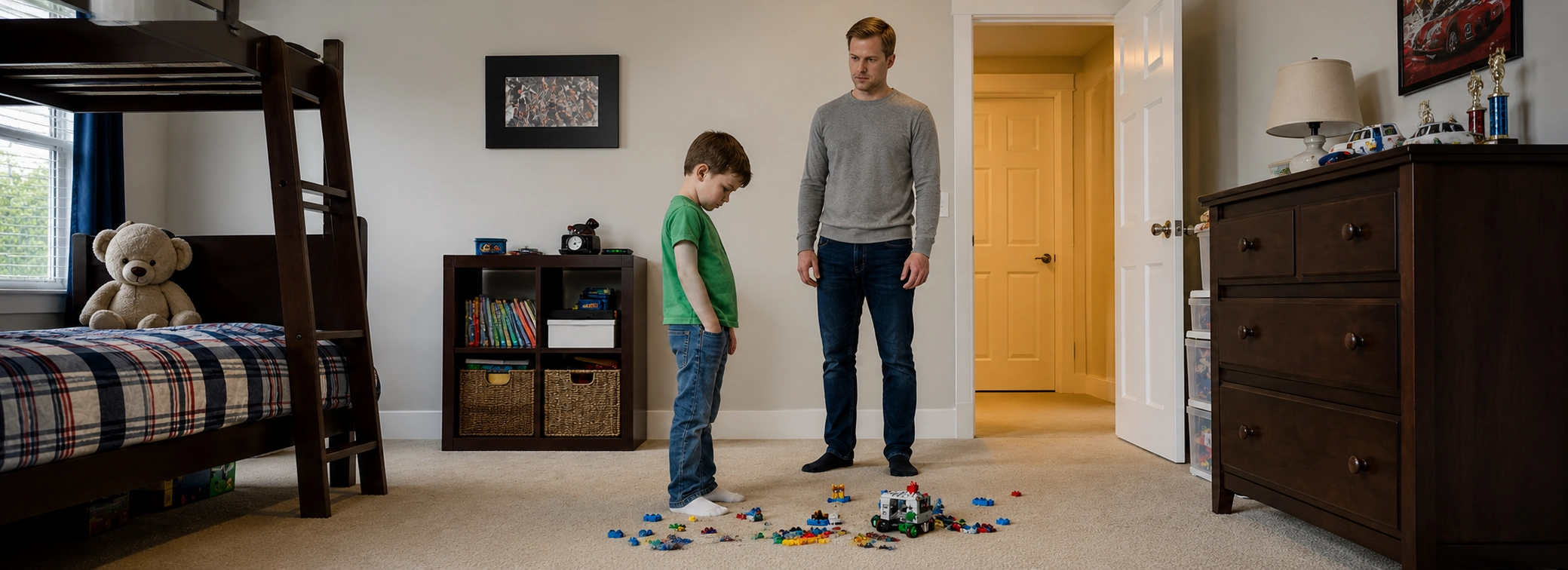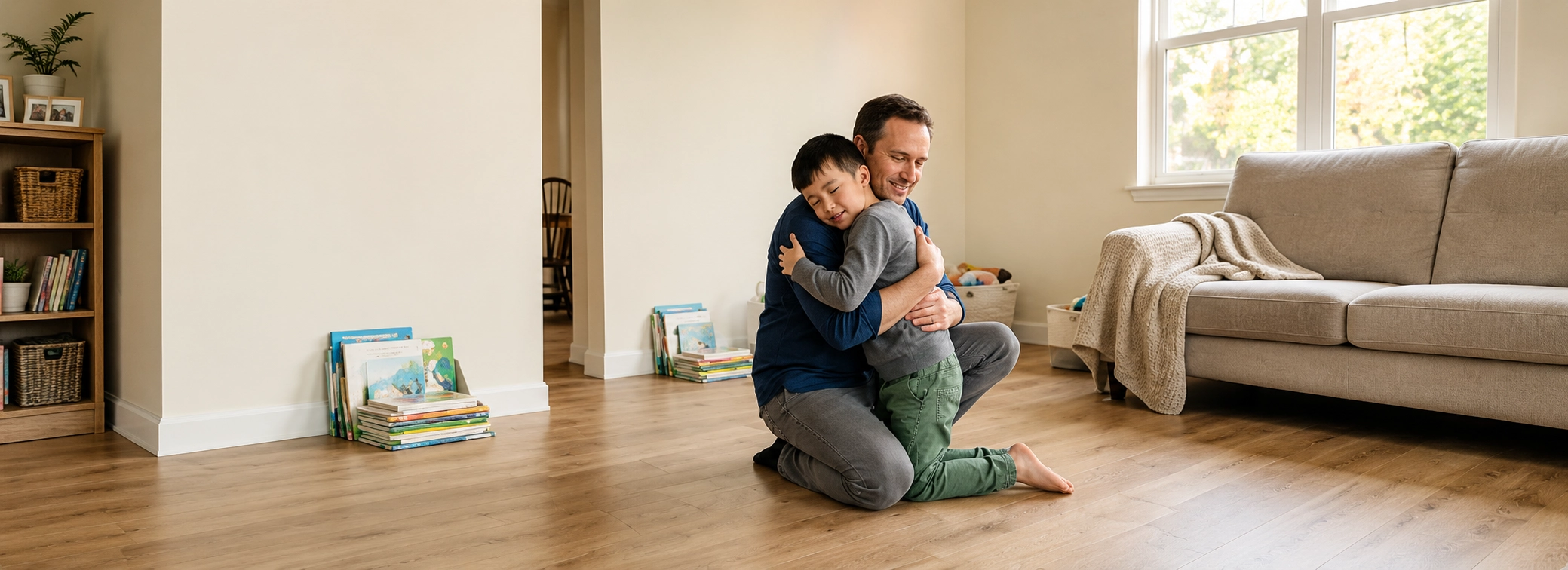
If your kid is calm and well-behaved at school but falls apart the moment they get home, you are not doing anything wrong, and it is actually a good sign. Holding it together all day at school takes real effort, and it slowly drains your kid's tank of self-control. By the time they reach you, the person they feel safest with, the tank is empty and the holding lets go. The home meltdown is not a sign of a bad relationship; it is proof of a strong one. The most helpful thing you can do is give the first twenty minutes after school as a calm, low-demand window, no questions, no corrections, just a snack and your steady presence.
The teacher tells you he was wonderful today: cooperative, focused, a joy to have in class. Then he gets in the car and within four minutes he is in tears about something you cannot identify. By the time you reach home, there is a full meltdown underway.
You start to wonder if you are doing something wrong, whether there is something about you, specifically, that brings this out. Whether other parents collect kids who are glad to see them, rather than kids who seem to have saved their worst for the moment you arrive.
Here is what is actually happening, and why, once you understand it, it becomes something to feel good about rather than something to worry about.
The teacher's report and your experience, why they describe different kids
The kid your kid's teacher sees is real. The kid you see at home is also real. They are the same kid in two very different states.
The school version is the managed version. A kid who sits still, waits their turn, follows the rules, and handles the hundred small frustrations of a school day is doing something genuinely hard. They are holding themselves together, drawing on a limited store of focus and self-control to meet the demands of a place that requires it.
The home version is the unmanaged version. Not fake. It is genuinely them too, but it is the version that does not have to perform, the version that is finally allowed to just be whatever is actually going on inside. The difference is not a difference in character. It is a difference in how much self-control the setting demands, and how much your kid has left in the tank.
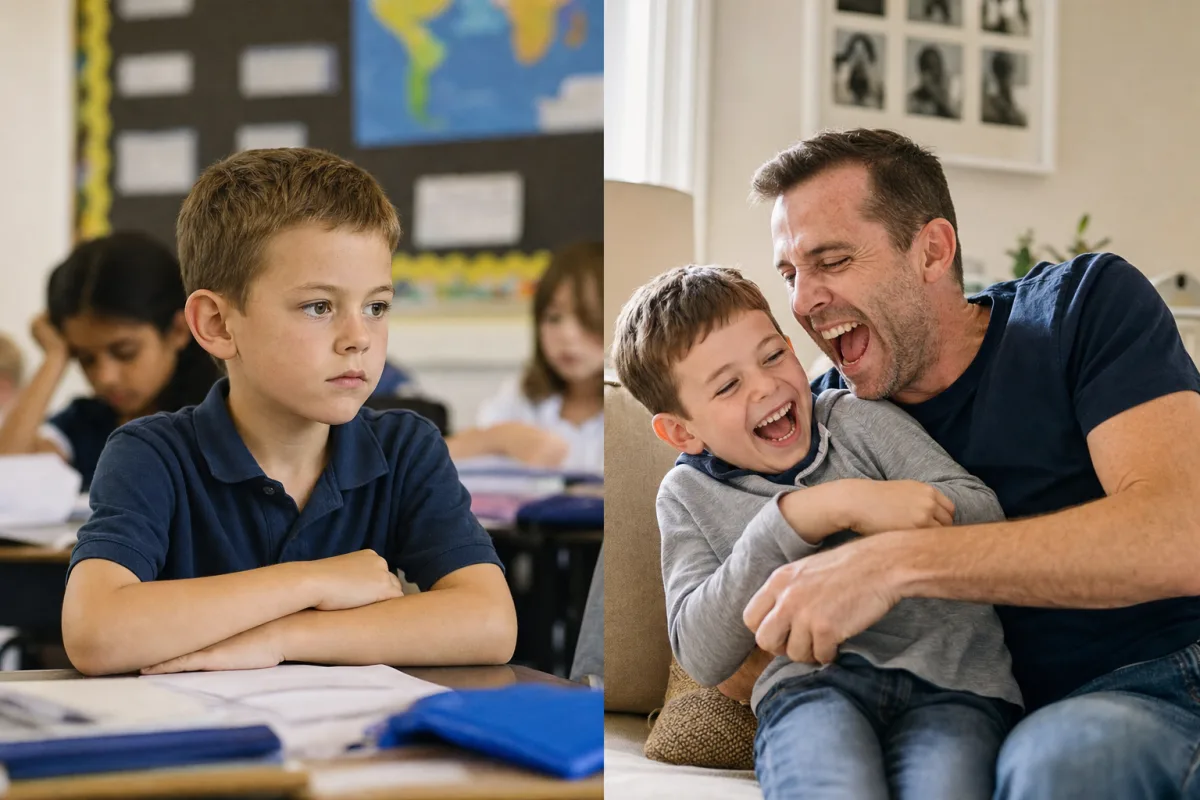 The kid who arrives home is not giving you a hard time. They are simply running on empty after a full day of managing themselves.
What your kid is actually doing all day at school
Most adults badly underestimate how much effort a school day takes, partly because we have forgotten what it is like to be a kid in that setting, and partly because a kid who is coping well is invisible. They are not causing problems, so no one sees the effort they are making.
Holding back the urge to speak before being called on. Staying in their seat when their body wants to move. Handling a disappointment on the playground, being left out of a game, losing, having a friend pick someone else, without you there to help them through the feeling. Reading the social signals of a busy classroom. Following instructions they do not understand or do not agree with. Making themselves care about things that do not interest them.
Each of these takes real effort, and each one draws from the same limited tank. A kid who manages all of them across a full school day has done a huge amount of quiet work. By home time, that tank is nearly empty. The behaviour that follows is simply what happens when a kid who has been working hard all day finally reaches the one place where they no longer have to.
The kid holds it together all day because the environment requires it. They let it go at home because the relationship allows it. Both of these are exactly as they should be.
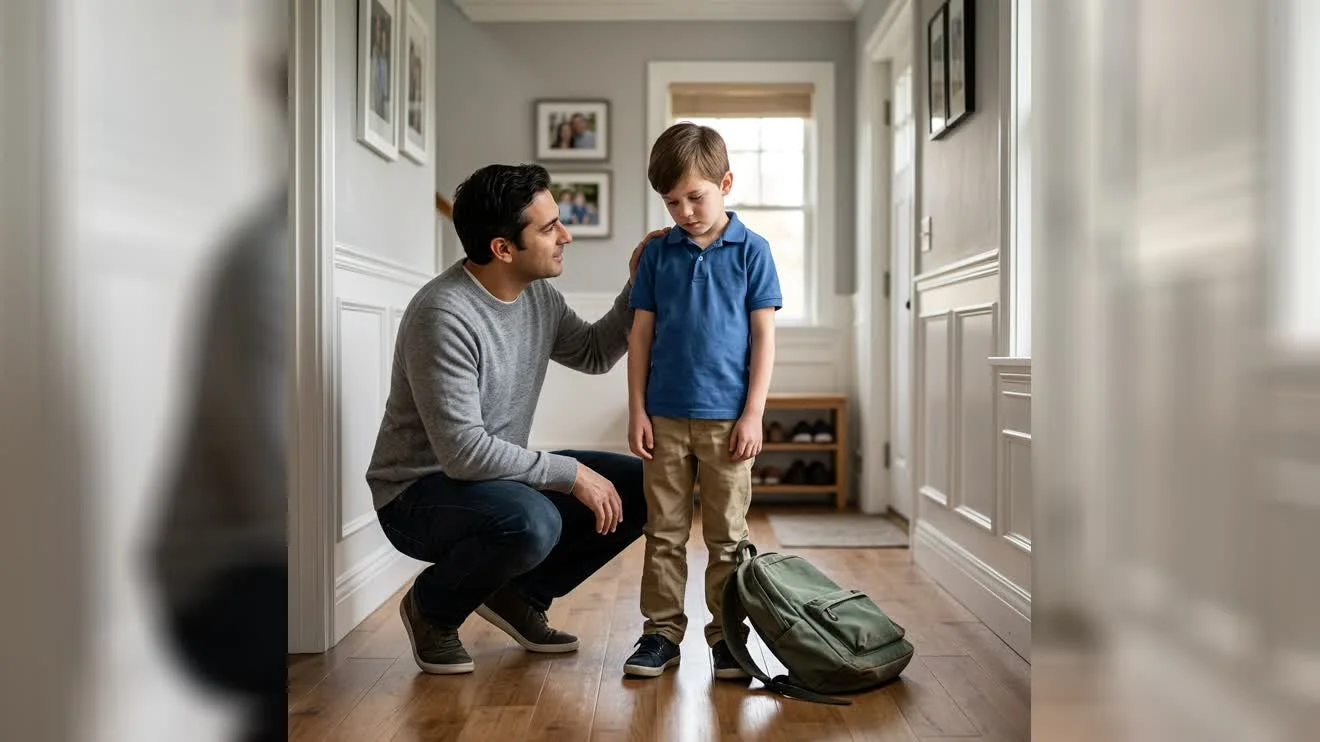 A kid holds it together all day because the environment requires it. They let it go at home because the relationship allows it.
The safe-person effect, why you get the worst of it
Research on attachment, the bond between a kid and the people they rely on most, has shown again and again that kids let their guard down most fully with the person they feel safest with. The parent a kid is most securely attached to is also the one in whose presence they feel most able to release everything they have been holding in.
This happens because feeling secure means, at its heart, trusting that a relationship can handle whatever comes. A kid who has known steady warmth, reliable repair after hard moments, and consistent presence builds an inner sense that says: this relationship is safe enough. When I am with this person, I do not have to manage. I can just be whatever I actually am right now.
So the meltdown with you is not a failure of your relationship. It is evidence of its strength. The kid who falls apart with you has quietly judged the relationship to be safe enough to hold this, and certain enough to survive whatever comes out.
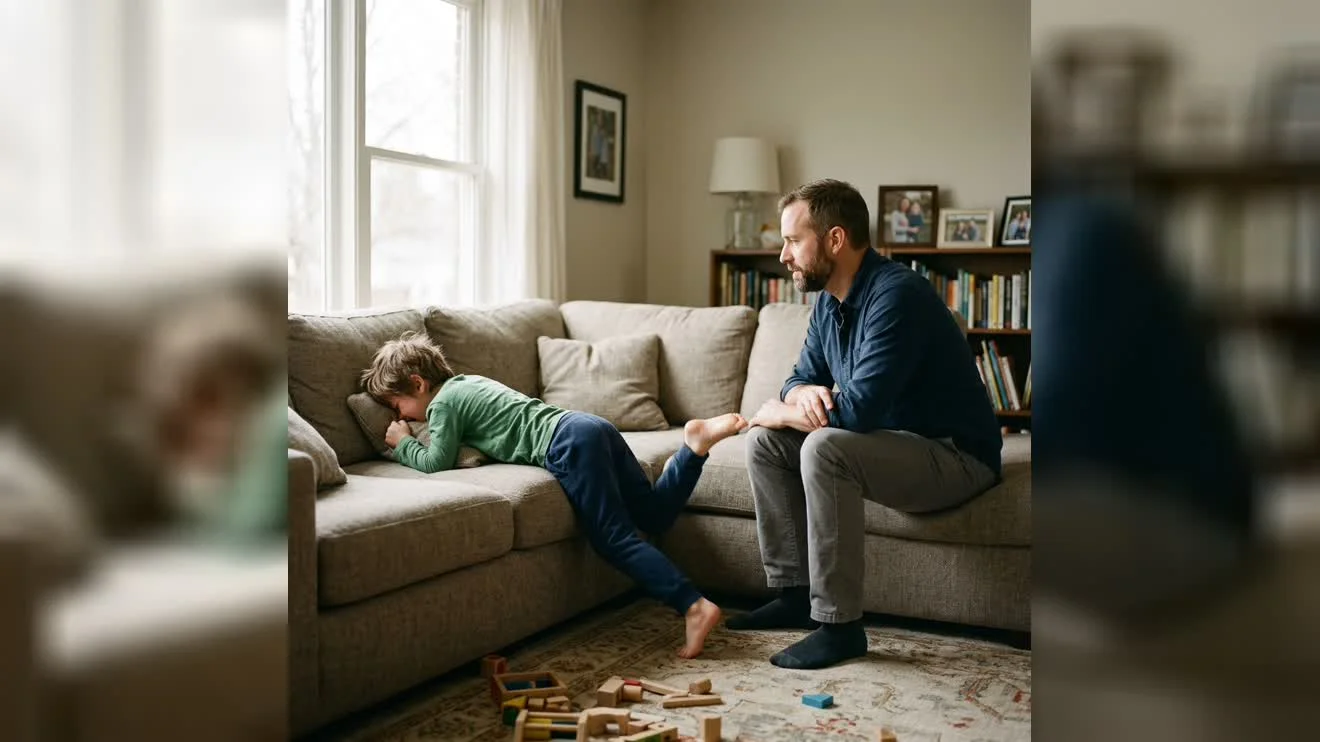 The meltdown is not a complaint about your return. It is the release of everything they held together while you were away.
WHAT THE TEACHER'S EASE ACTUALLY TELLS YOU
The teacher's relative ease with your kid is not proof of better technique. It is a sign that your kid is performing self-control for someone whose approval feels less certain. The teacher's approval matters to your kid, and it could be lost, so they work to keep it. Your love, by contrast, is not something your kid believes can be taken away by bad behaviour, and so they do not work to keep it in the same way. This is the highest compliment a kid can pay a parent: the certainty that the relationship does not require a performance.
Help Shape the Future of Active Learning
Join our exclusive Founding Member program. Get early access to new interactive modules, direct input into our product roadmap, and lifetime pricing options.
The kid who is difficult everywhere, a different concern
It is worth naming directly: a kid who is extremely difficult at home and extremely difficult at school is a different situation from one who is difficult only at home. The pattern in this article, angel at school, hard work at home, is a sign of a secure, working relationship. It is not a problem to fix.
A kid who cannot manage their behaviour in any setting, who struggles to settle no matter where they are or who they are with, may be carrying a load that is too heavy everywhere, not just at home. That pattern deserves a different kind of attention, a conversation with a paediatrician or child psychologist who can help work out what is driving the constant difficulty. In short: if your kid is only difficult with you. That is attachment working as it should. If your kid is difficult everywhere. That is a signal worth following up.
What to do at the end of the school day
Understanding the mechanism does not make the afternoon meltdowns vanish, but it does make them easier to handle, and it points to some practical changes that can reduce how often and how hard they hit.
The most powerful thing you can do in the first twenty minutes after school is to ask nothing of your kid that requires self-control. No questions about their day, no requests, no corrections, no activities that add to the load. Just presence. A snack if they want one. A gentle, low-demand bridge from school back to home.
The questions you genuinely want to ask, how the day went, what happened, land far better after this wind-down window. A kid who has had twenty minutes to arrive home, eat something, and simply exist without demands is in a much better state to answer “how was your day” than a kid still caught between school and home.
 A gentle, low-demand bridge from school back to home can change the mood of the whole evening.
The reconnection that changes the evening
One kind of contact matters most in the first few minutes of reunion, not information, not instructions, not activity, but genuine, warm, focused attention. A moment of real connection where your kid feels you are fully present and glad to see them, specifically.
This does not need to be long or elaborate. It can be as simple as real eye contact, one question that shows you know who they are right now, and listening to the answer without doing three other things at once. A kid whose parent does this regularly, even briefly, carries that connection into the rest of the evening. A kid who comes home to a distracted parent carries the absence of it instead. The meltdowns do not disappear, but they tend to be shorter, gentler, and quicker to resolve when the evening starts with real contact rather than distraction.
When to seek a bit more support
The angel-at-school, hard-work-at-home pattern is normal and healthy, and most of it eases as your kid grows and their self-control develops. Still, a few things are worth a chat with your GP, paediatrician, or a child psychologist. One is home aggression that is getting worse rather than better. Another is a kid who seems to be struggling at school as well as at home. A third is meltdowns that are clearly affecting friendships, learning, or family life day after day. Trusting your gut here is not overreacting. It is simply getting support and reassurance early.
Is Your Kid's Screen Time Active or Passive?
Most screens capture a kid's attention without checking their understanding. Take our 2-minute diagnostic quiz to evaluate your kid's digital patterns, identify autoplay traps, and receive actionable insights to maximize active learning.
Start Screen Time & AI QuizFOR PARENTS
Parental Intelligence on Aiino keeps you connected to what your kid carries.
Knowing what your kid explored, asked about, and got curious about during their day makes the reunion conversation more specific and more connecting. Parental Intelligence gives you the small details that turn “how was your day” into a question that actually lands. Built for kids aged 3 to 9. Zero ads. Zero tracking.
Research Citations
- [1]Securely attached kids regulate their emotions better and use that safe relationship to express and work through distress (Cooke et al., Emotion, 2019). Emotion. View source →
- [2]Secure attachment shows up less as having smaller feelings and more as recovering from big ones with a caregiver's help (Obeldobel, Brumariu, & Kerns, Emotion Review, 2023). Emotion Review. View source →