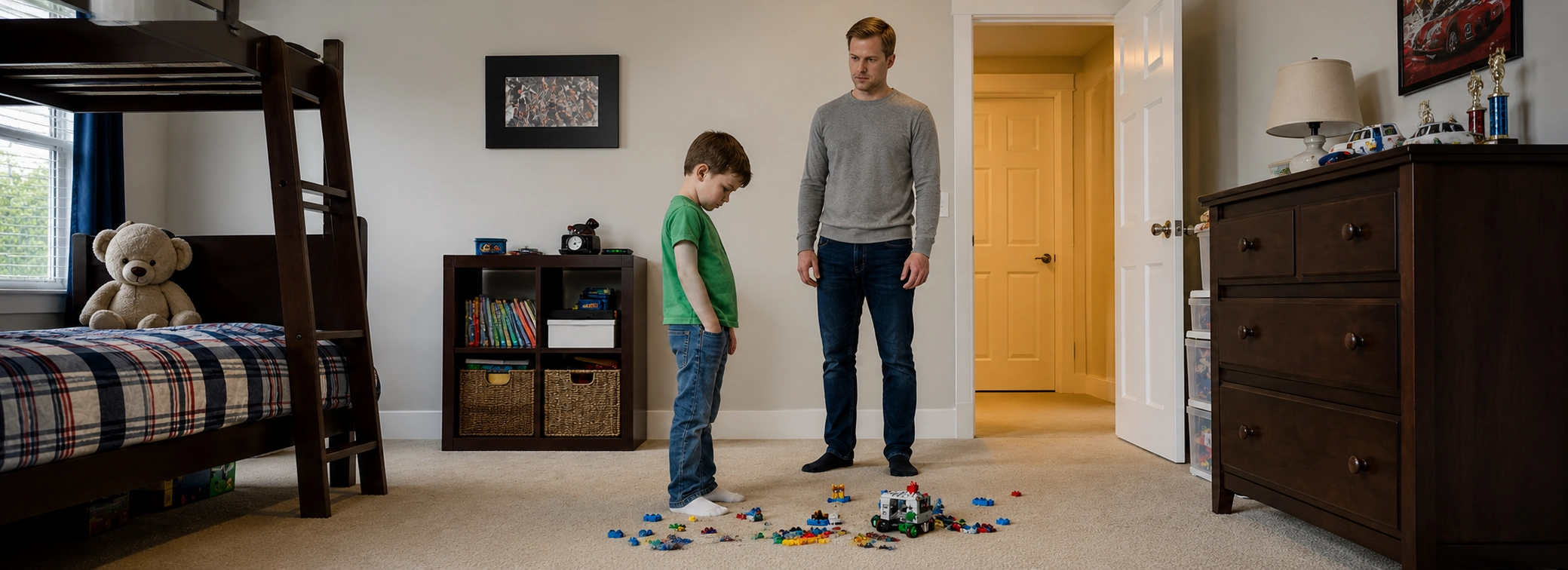
A kid's confidence is not built through praise alone. It is built through the experience of trying things, struggling, and getting through. Research consistently shows that praising a kid for being "smart" or "talented" actually makes them less willing to take on hard challenges, because they become scared of losing that label. The praise that genuinely builds confidence is specific and focused on effort and process, not fixed qualities. But even more important than praise is the simple act of allowing kids to try, to fail at small things, and to discover they can handle it. The parent who steps in too quickly, or praises too generally, is quietly working against the very confidence they are trying to build.
Your five-year-old announces she wants to pour her own juice. She has spilled before. You know she will probably spill again. You reach for the carton, and she pulls it back. "I can do it myself."
This moment, frustrating as it sometimes feels, is one of the most important things that will happen in your kid's development this week. What looks like stubbornness is actually something much bigger: your kid is testing whether she is the kind of person who can do things.
Her answer to that question, built across thousands of small moments like this one, will shape how she approaches hard things for the rest of her life. Not eventually. Now. This is the window.
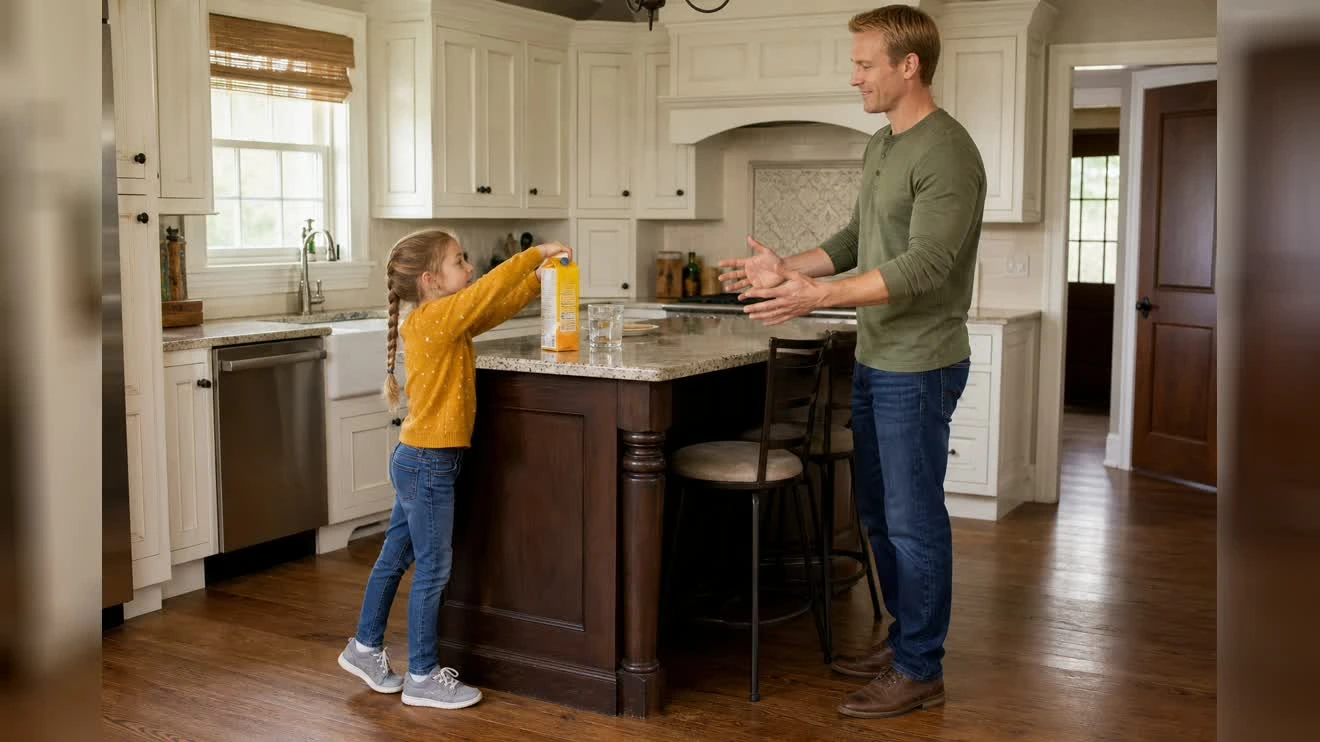 What looks like stubbornness is your kid testing whether she is the kind of person who can do things.
The Developmental Stages That Explain It All
The psychologist Erik Erikson described childhood development as a series of questions that kids work through at different ages. Two of these questions are directly relevant to how confidence develops between ages three and nine, and understanding them changes how parents see their kid's behavior.
Ages 3 to 6, Initiative versus Guilt
Between ages three and six, kids are working on what Erikson called the "initiative versus guilt" stage [1]. The core question of this stage is simple: Am I allowed to want things? Am I allowed to try? When a kid takes initiative, starts a project, makes a choice, attempts a task, and the response from the adults around them is warm and encouraging, they develop a sense that their actions matter. They feel that reaching for something is allowed.
When that same initiative is consistently met with criticism, dismissal, or an adult simply doing the thing for them, something different develops. A hesitation. A habit of waiting for permission. A smaller sense of how much space they are allowed to take up in the world. Erikson believed that when this stage goes wrong, kids develop a sense of guilt about their own desires and ambitions, a quiet feeling that wanting things and trying things is somehow problematic.
The kid who is never allowed to try will eventually stop wanting to. Not because they lost interest in the world. Because they lost faith in themselves as someone who can engage with it.
Ages 6 to 9, Industry versus Inferiority
Around age six, the question shifts. Kids move from wanting to try things to wanting to be good at them. This is Erikson's "industry versus inferiority" stage [1]. Kids at this age become intensely aware of how they compare, to classmates, to older siblings, to their own idea of what they should be able to do. They are constantly looking for evidence about where they stand.
 Every small success is a brick in the foundation, and every time you step in too early, one gets taken away.
When kids experience success and feel genuinely competent at things that matter to them, they build what Erikson called a "sense of industry", a belief in their own ability to do and make and achieve. When they experience persistent failure, dismissal, or feel they can never measure up, they develop a sense of inferiority that, Erikson argued, can follow a person well into adult life.
This is why the stakes of how you respond to effort, not just results, are so high in these years. Every small success is a brick in the foundation. Every dismissal or unfair comparison is one taken away.
Ages 3 to 6 The Question Every Young Kid Is Secretly Asking
A kid between three and six is not just playing. They are running constant experiments on the world to answer one question: "When I reach for something, what happens?" And the answer they get, across hundreds of tiny daily moments, builds either a "yes, reaching is allowed and I can do things" or a "no, the world is not for me to act on."
This is why being allowed to pour the juice matters so much more than whether the juice gets spilled. The spill is a five-second problem. The answer to "am I capable?" is a lifelong one. And right now, in this window, your kid's brain is collecting evidence for the answer.
A MOMENT MOST PARENTS RECOGNIZE
Your four-year-old insists on buttoning their own coat. They are slow. You are late. You reach over and do it. They look at you with an expression you cannot quite read, not quite anger, not quite sadness. They do not try to button the coat themselves again for the next three weeks. They were not sulking. They had just updated their answer to "am I someone who does things myself?" And the answer had quietly become "no, apparently not."
Help Shape the Future of Active Learning
Join our exclusive Founding Member program. Get early access to new interactive modules, direct input into our product roadmap, and lifetime pricing options.
Research confirms what parents sense intuitively. A 2023 study in the Early childhood Education Journal found that the single most important source of self-belief in young kids is what researchers call "mastery experience", the direct experience of attempting something and getting through it [2]. Not being told they can do things. Not being praised for their qualities. Actually doing something and surviving the attempt, including the messy parts.
Ages 6 to 9, When Comparison Becomes the Measuring Stick
Something shifts around age six or seven. The kid who was previously focused on their own experience: "can I do this?", becomes focused on a more socially comparative question: "How do I do compared to everyone else?"
This is completely normal. It is a developmental stage. Kids at this age use peers as a measuring stick constantly. They notice who finishes their work first, who gets praised by the teacher, who is picked first for the team, whose drawing gets put on the wall. They are building a picture of where they stand, and every data point matters to them in a way that can seem disproportionate to adults.
The kid who falls apart when they lose a board game is not being dramatic. The kid who crumples when their drawing is not praised is not being needy. They are in the middle of a serious developmental project: figuring out whether they are competent or inadequate. And every small event is evidence for one side or the other.
THE DRAWING ON THE TABLE
Your seven-year-old spends twenty minutes on a drawing. They hold it up to show you. You are busy. You say "nice" without really looking. They put it face-down on the table and do not show you another drawing for two weeks. They were not looking for approval. They were looking for evidence that what they made was real, that it existed and mattered in someone else's world. The one-word response told them it did not.
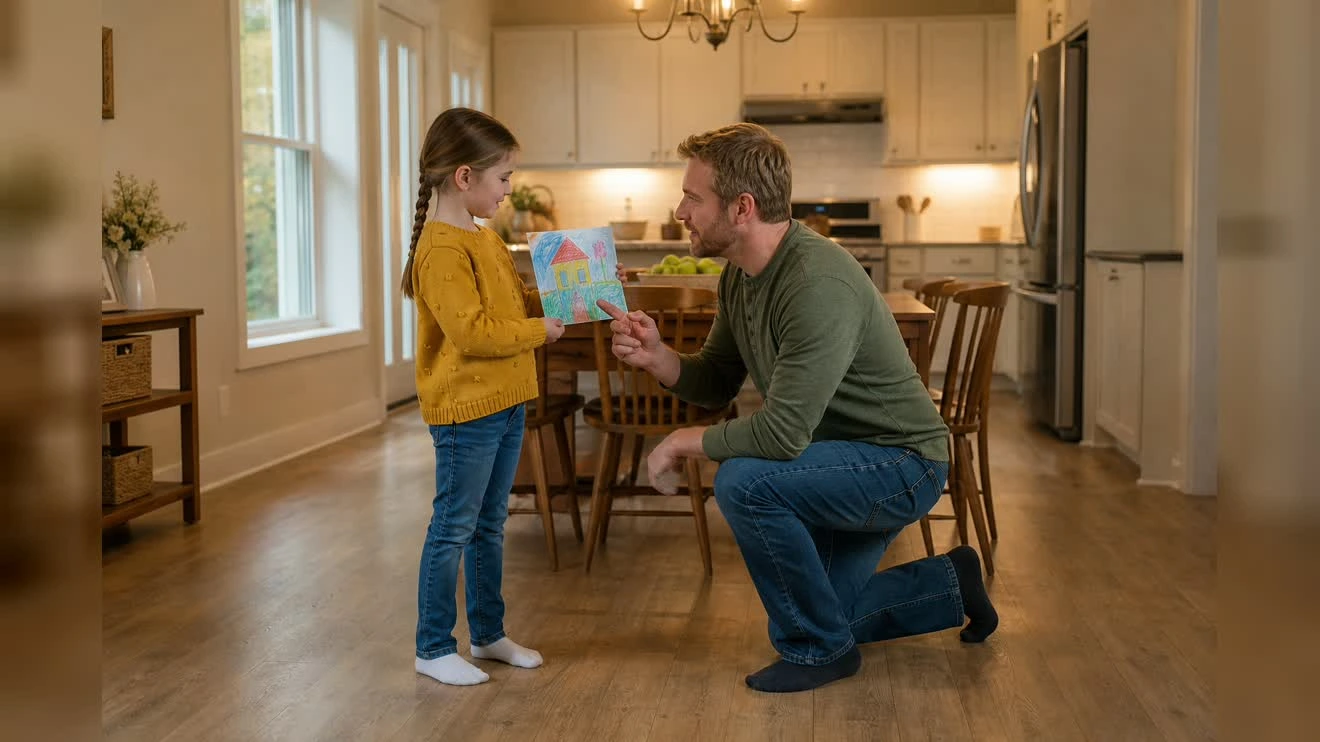 She was not looking for approval. She was looking for evidence that what she made was real.
Is Your Kid's Screen Time Active or Passive?
Most screens capture a kid's attention without checking their understanding. Take our 2-minute diagnostic quiz to evaluate your kid's digital patterns, identify autoplay traps, and receive actionable insights to maximize active learning.
Start Screen Time & AI QuizThis does not mean parents need to perform enthusiasm for every drawing. It means that what you give your attention to, specifically, for long enough to really see it, communicates to your kid what is worth attempting. A kid whose attempts consistently go unseen or receive only vague acknowledgment gradually learns to make fewer attempts.
The Praise That Builds and the Praise That Quietly Undermines
Carol Dweck is a psychologist at Stanford University who has spent decades studying how praise affects kids's willingness to take on challenges and bounce back from setbacks. Her findings changed how many schools and parents think about encouragement, and they are worth understanding specifically.
In studies with kids aged four to twelve, Dweck found that praising a kid for a fixed quality: "you are so smart," "you are so talented," "you are a natural", actually made them less willing to take on hard challenges afterward. Why? Because they became scared of doing anything that might show they were not smart or talented after all [3]. The praise that was supposed to build confidence had quietly created a fear of failure.
“When we praised kids for their ability after a success, they were more likely to reject challenges and fall apart when they hit difficulty. Praising ability puts kids in a fixed mindset and makes them vulnerable.”
— Carol Dweck, Stanford University
The praise that actually builds real confidence is different. It is specific. It is focused on what the kid did, the process, the effort, the strategy, rather than what they are. "I noticed how you kept trying even when that part was really hard" is fundamentally different from "you are so clever." The first says: you have a way of being in the world that works. The second says: you have a quality that you might lose.
Research published in 2024 confirmed what Dweck's original work had found: kids who hear more process-focused praise in early childhood develop a stronger belief that they can grow and improve. This belief, built up across childhood, is associated with better school performance and greater willingness to take on hard things [4]. The words parents use in ordinary daily moments are genuinely building something that lasts.
Specific praise that actually helps
"I saw how hard you kept trying even when it was frustrating.", This builds persistence.
"You figured out a different way to do it when the first way did not work.", This builds creative problem-solving.
"That was a really hard thing and you stayed with it.", This builds the sense that hard things are survivable.
"You did not know how to do that a month ago.", This builds the understanding that ability grows over time.
What Giving Up, Perfectionism, and Needing Reassurance All Have in Common
Three patterns appear very commonly in kids aged three to nine, and they look very different on the surface. But they all come from the same place.
The kid who gives up the moment something is hard. This kid has learned, through experience, that effort and failure feel the same. If trying hard and still failing produces the same result as not trying, then trying starts to seem pointless. The giving up is not laziness. It is a rational response to a painful pattern.
The kid who needs constant reassurance. This kid has not yet had enough experiences of trusting their own judgment. They have not accumulated enough evidence that their own internal sense of "I did well" is reliable. So they outsource the judgment constantly, checking with adults to find out whether what they did was acceptable.
The perfectionist who will not hand in work until it is completely flawless. This kid is not ambitious in the healthy sense. They are scared. They have built a story that their value depends on their output being perfect, and that any imperfection is evidence of fundamental inadequacy. The extreme standard is a protection against the thing they fear most: being found to not be enough.
All three patterns are completely workable. None of them are fixed in a kid's character. They are the natural result of a developmental stage that is extremely sensitive to how the adults around a kid respond to their attempts at the world. The pattern can be shifted, gradually, through consistent experience that tells a different story.
What Parents Can Actually Do, Practical and Specific
Allow the attempt before the outcome
Before stepping in to help, pause for longer than feels comfortable. The kid who is struggling with the buttons, the zip, the puzzle, the impossible knot. They are doing developmental work in that struggle. The moment you step in, the work stops. Ask yourself: is this genuinely beyond them, or is it just taking longer than I want to wait? The answer determines whether helping is kind or quietly undermining.
Praise the process every single time
Make it a habit: when you praise, praise what you saw them do, not what they are. "You tried three different ways until it worked" rather than "you are so clever." This takes practice, the natural impulse is to praise quality, but it becomes easier with repetition. And the effect compounds over time. The kid who hears process praise consistently builds a different relationship with challenge than the kid who hears only quality praise.
Let small failures happen without rescuing
The spilled juice matters less than what happens after. A calm, matter-of-fact response: "oh, let's wipe it up", followed by "do you want to try again?" teaches two things simultaneously. First: failure is not a catastrophe. Second: failure is followed by another attempt, not by being taken over. These two lessons, repeated across hundreds of small incidents, build the resilience that big challenges later in life will require.
 Failure is not a catastrophe, it is followed by another attempt, not by being taken over.
Give attention that is specific and unhurried
When a kid brings you something, a drawing, a story, a thing they made, stop what you are doing long enough to actually see it. Ask one specific question: "What is happening in this part?" or "How did you decide to make it this color?" The specific question communicates that you looked. That it exists in your world. That it was worth making. This is not expensive in time. It takes ninety seconds. But for the kid, it answers the question they were actually asking: "Does what I make matter?"
The Parent Who Steps In Too Quickly
There is a pattern that develops so naturally it is hard to see: the parent who loves their kid deeply, who wants life to be smoother for them than it was for themselves, who steps in just a little bit early, every time.
This parent is not doing anything wrong in any individual moment. Helping a kid do up their zip when they are struggling is not harmful. Helping once. But when the pattern is consistent, when the kid learns, across hundreds of moments, that difficulty will be resolved by the adult rather than by themselves, something quiet happens. The kid stops reaching for the thing. Not because they cannot do it. Because they have learned that reaching is not their job.
Research into self-belief in kids consistently finds that the most important thing a parent can provide is not protection from difficulty. It is the experience of being supported while going through difficulty and coming out the other side [2]. Those are different things. Protection from difficulty removes the experience. Support through difficulty preserves it. The kid who has support but not rescue builds something that the kid who is always rescued never gets to build: the knowledge that they can handle hard things themselves.
"The confidence kids carry into adult life is built in the moments when they discovered they could handle something difficult, not in the moments when something difficult was handled for them."
This does not mean parents should manufacture difficulty or withhold appropriate help. It means being honest with yourself about which situations require intervention and which require patience. The difference is usually visible: genuine inability to do something versus simply not having done it before. One requires help. The other requires time and the quiet message that trying is what is wanted here.
Research Citations
- [1]Erikson, E.H. (1963). "childhood and Society, Psychosocial Stages of Development." W.W. Norton & Company. Reviewed and summarized in Simply Psychology (2025). View source →
- [2]Pearce, N., et al. (2023). "Teachers' Understanding of the Major Sources of Self-Efficacy in Early childhood." Early childhood Education Journal, Springer Nature. View source →
- [3]Dweck, C.S. (2024). "Growth Mindset and the Future of Our Kids, Process praise versus ability praise." Parents League of New York, research summary. View source →
- [4]Gunderson, E.A., et al. (2024). "Effects of praise and easy feedback on kids's persistence and self-evaluations." Journal of Experimental Kid Psychology, ScienceDirect. View source →
- [5]Foroughi, B., et al. (2023). "I think I can, I think I can't: Design principles for fostering a growth mindset in the early years." Early childhood Education Journal, Taylor & Francis Online. View source →
- [6]Pua, E.P.K., et al. (2025). "Factors influencing self-confidence among adolescents and kids: a systematic review." Discover Education, Springer Nature. View source →