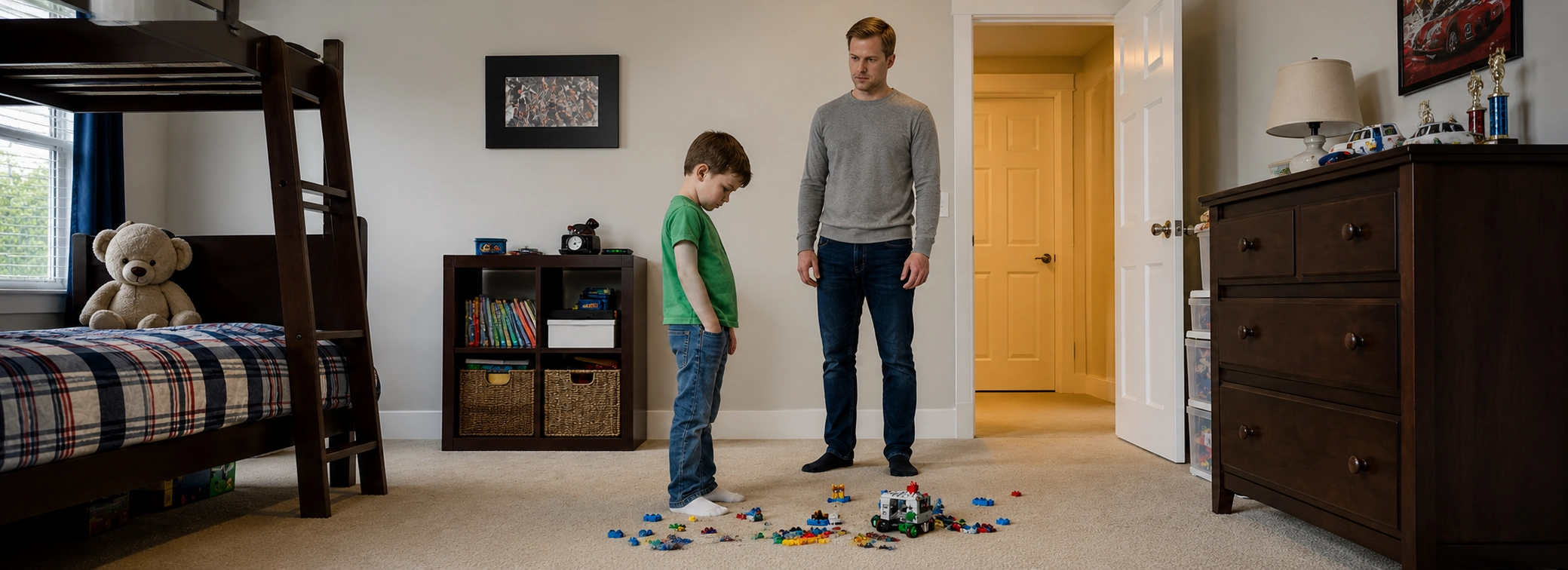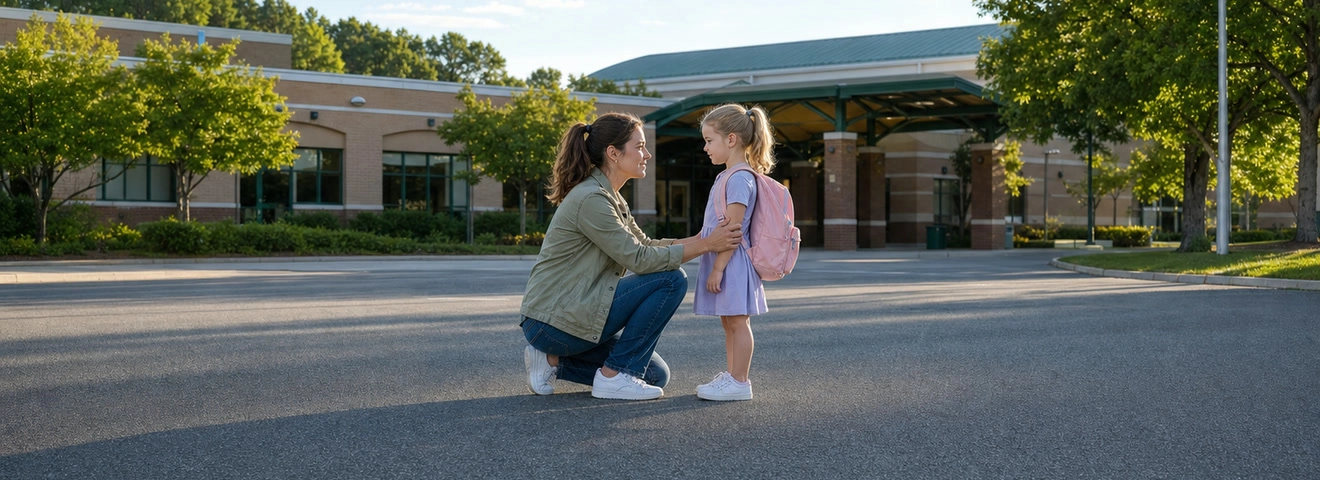
A meltdown is not bad behaviour, and it is not a choice. It is what happens when the “thinking” part of your kid's brain gets flooded and switches off, and in kids aged 3 to 9, that part is still being built. Your kid literally cannot stop the meltdown; they can only get through it. So in the moment, do not reason, explain, or punish. Get down to their level, stay calm, and let them borrow your calm with a few simple words: “I'm here. I've got you.” That steadiness is what helps their brain settle, and over time. It is how they learn to settle themselves.
Somewhere between “we're leaving in five minutes” and the front door, your kid has collapsed. Not in a dramatic, attention-seeking way, on the floor, genuinely undone, because their sock is twisted. If you have a kid between about three and nine, you have probably lived some version of this.
You have tried reasoning, and you have tried ignoring it. You have tried matching their energy with your own frustration, which helped no one. You have googled “why does my kid react so strongly to small things” at eleven at night and found a list of tips that all assume your kid can actually hear them in that moment.
Here is what those tips miss: by the time the meltdown is happening, the part of your kid's brain in charge of choices has gone completely offline. You are not dealing with a kid who will not calm down. You are dealing with a kid who cannot, yet, because the brain wiring for it is still being built.
This article explains what is really happening, and exactly what to do about it.
 By the time the meltdown arrives, the thinking brain is already offline, your kid cannot hear the tips.
What is actually happening in your kid's brain
Your kid's brain handles big feelings using two parts that are always in conversation with each other.
The first is the alarm. Deep in the brain sits a small, almond-shaped part called the amygdala, think of it as a smoke alarm. Fast, automatic, and always scanning for danger, it floods the body with stress chemicals the moment it senses a threat, priming your kid to fight, run, or freeze. All of this happens before any conscious thinking is involved.
The second is the brake. Behind the forehead is the “thinking” part of the brain (its proper name is the prefrontal cortex). In a grown-up it works well: it can look at the blaring alarm and decide “it's just a twisted sock, we can fix this in ten seconds.” It is what lets adults feel frustrated without falling apart.
In kids aged 3 to 9, that brake is barely built. The wiring that connects the alarm to the brake does not finish developing until the mid-twenties, and in a young kid the connection is not just weak. It actually works differently from an adult's. Under real stress, the brake simply cannot catch the alarm in time.
So when the sock is twisted, the alarm blares, stress chemicals flood in, and the thinking brain that would normally say “this is fixable” goes quiet. Your kid is not overreacting. Their brain is doing exactly what a young brain is wired to do.
A meltdown isn't bad behaviour. It is a young brain doing exactly what young brains do when the load grows bigger than they can handle.
Why this alarm system exists at all
It helps to understand why kids come wired this way, because the alarm is not a design flaw. It is one of the most important tools we have. Picture an animal that pauses to calmly weigh up whether the rustle in the grass is a predator: it does not last long. The fast alarm that overrides careful thinking has kept living things alive for millions of years.
Kids are born with it already switched on. They arrive in a world they do not fully understand, depending on adults whose moods they cannot predict, and handling a flood of sights, sounds, and demands all at once. The system is working perfectly. The only problem is that it cannot yet tell the difference between real danger and a sock that feels wrong, to the alarm, the feeling is the same, and a young kid cannot override it with logic, because that ability is simply not ready yet.
A MOMENT YOU MIGHT RECOGNISE
It's 7:55am, and your kid needs to leave for school at 8:00. She has been awake since 5:30. She skipped breakfast because she wasn't hungry. She has been bickering with her brother for twenty minutes. Then the sock is twisted. From the outside, it looks like a huge reaction to a tiny problem. From inside her nervous system, the alarm has been running on high for two and a half hours, and the twisted sock is just one more signal it cannot handle. The meltdown is not about the sock. The sock was the last drop in a cup that was already full.
Help Shape the Future of Active Learning
Join our exclusive Founding Member program. Get early access to new interactive modules, direct input into our product roadmap, and lifetime pricing options.
 The meltdown is rarely about the sock. It is the last drop in a cup that was already full.
Why the blue cup is never really about the blue cup
Parents learn quickly that the thing a meltdown is “about”, the blue cup, the broken biscuit, the wrong colour socks, is almost never the real cause. It is just the last straw.
Picture your kid's ability to cope as a cup. Every demand of the day adds a little water: getting dressed, the noise of school, holding in big feelings, a tricky moment with a friend. By late afternoon the cup is nearly full, and the blue cup is simply the drop that makes it spill over.
This matters not as an excuse but as a clue. When you stop asking “why is this such a big deal?” and start asking “how full was the cup already?”, the meltdown finally makes sense. You are not looking at a spoiled kid. You are looking at a full cup.
The five most common triggers, and the one parents miss
1. Not enough sleep
The thinking brain is very sensitive to tiredness, and even a little less sleep than usual makes the alarm louder and the brake weaker. An overtired kid is set up to tip over, and often the only fix that truly works is more sleep.
2. Hunger
When blood sugar drops, the alarm gets twitchier. “Hangry” is a real thing: a hungry kid is, in a genuine sense, closer to a meltdown, and it is biology rather than attitude. Sometimes a snack is the whole answer.
3. Too many changes in a row
Young brains are slow to switch from one thing to the next, so stopping play to come to dinner, leaving the park, or moving from home to school each costs more energy than it does for an adult. A kid who loses it when asked to stop playing is not being defiant, their brain is still catching up to the change.
4. Too much going on
Loud, bright, crowded, busy places keep the senses working overtime. The supermarket meltdown, the birthday-party meltdown, the shopping-centre meltdown, these usually mean the world was asking more of your kid's senses than they had left to give.
5. A full day of “being good”, the one parents miss
School asks a huge amount of kids. Managing friendships, following rules, and holding it together for six or seven hours uses up the very same energy they need for self-control, so by the time they reach you the tank is often empty. That is why the meltdown so often lands at home, which brings us to the point parents most often miss.
By the time your kid gets to you at the end of the day, that energy is often spent. This is why the meltdown shows up at home, with you, right after a teacher described them as “perfect all day.” They held it together because school required it, and the moment they see the person they trust most, the holding lets go. You get the meltdown no one else saw, not because you did something wrong, but because you are the safe place where it is finally okay to fall apart. We will come back to this.
What “co-regulation” means and why it is the only thing that works
The word experts use is co-regulation. In plain terms, a kid who cannot calm down on their own borrows calm from a steady adult nearby, and it is the single most powerful tool you have.
This is not just a nice idea. It can be measured. When a calm adult stays close to an upset kid, the kid's body, including heart rate and stress levels, actually settles. Calm is contagious. But it only works one way: if you are visibly stressed by the meltdown, you do not pass on calm. You add to the load.
This is the hardest part. The moment your kid is on the floor, screaming about a sock and making you late again, is the exact moment your own alarm wants to go off too. Staying calm then is not a personality trait. It is a skill, and like any skill, it gets stronger with practice.
Here is what borrowing your calm looks like in practice: stay close, lower your voice and your body, and stop trying to fix it. No long explanations, the thinking brain is offline right now. Maybe a hand on the back if touch is welcome, maybe just sitting nearby. The goal is not to stop the meltdown; it is to let it run its course in a calm space, so your kid's brain can find its way back using your calm as the anchor.
 A kid who cannot calm down alone borrows calm from a steady adult nearby, that is co-regulation.
A kid does not learn to calm down from being told how. They learn it by being calmed, again and again, by someone steady.
The repair matters more than the prevention
Most meltdown advice is about prevention, spotting triggers, keeping routines, enough sleep and food, and that matters. But the part with the biggest long-term payoff is what happens after the meltdown. The repair.
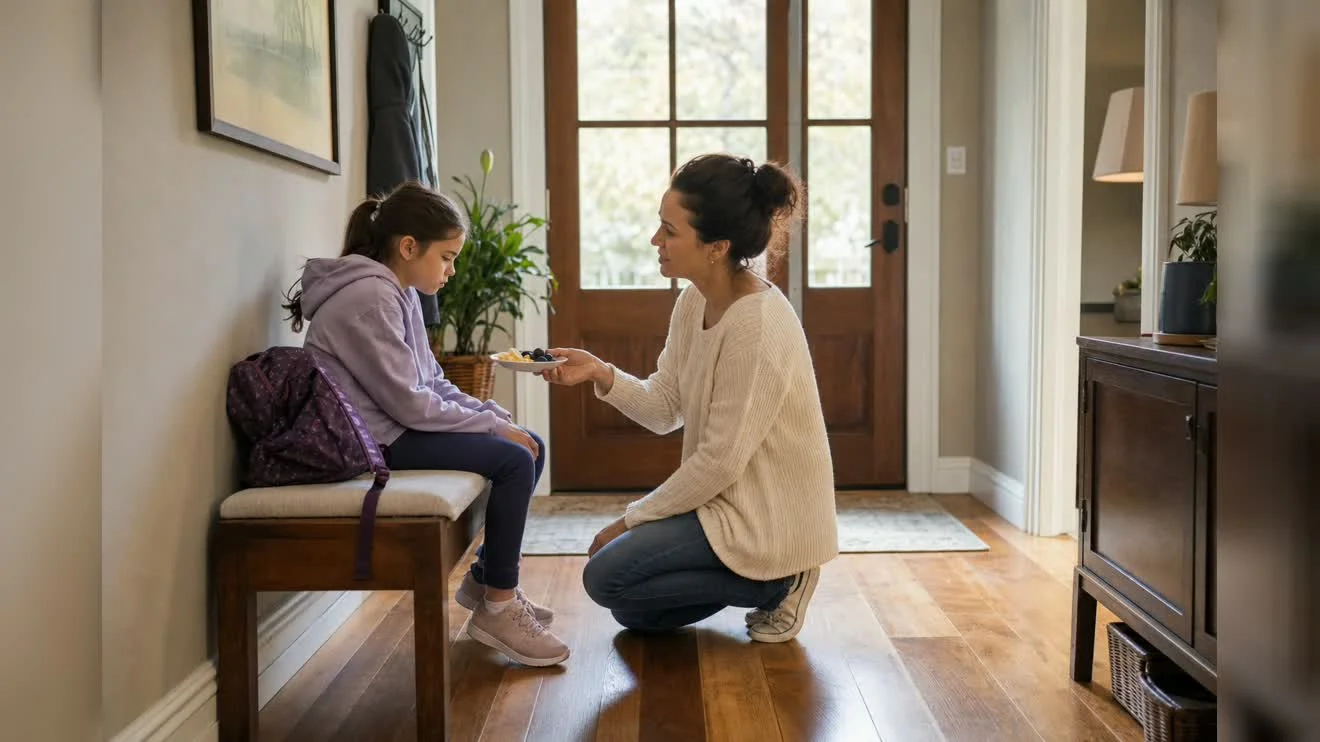
Repair is the moment, usually twenty to forty minutes later once your kid is fully calm again, when you reconnect. Not to talk about the behaviour, not to give a consequence, not to explain why the sock was not worth crying over. Just to reconnect, a short, warm, low-key moment that says one thing clearly: we are okay. You are safe. I am still here.
Here is why it is so powerful. Kids do not feel secure because nothing ever goes wrong between you; they feel secure because, when something does go wrong, you reliably come back. A kid who has meltdowns and then warm repairs learns something huge over time, that this relationship can survive their worst moments, and that love does not disappear when they lose control.
 The repair, a warm reconnection that says: we are okay, you are safe, I am still here.
Repeated across thousands of ordinary days. This is what slowly becomes self-control. Not from lectures, but from experience. The repair is not a consolation prize after a hard moment. It is the real work.
Four things that make it worse, and what to do instead
Explaining and reasoning mid-meltdown
“The sock is fine, look, there's nothing wrong with it.” The thinking brain that would process that is offline right now. Your kid is not refusing to hear you, the path between your words and the helpful part of their brain is temporarily closed. Reasoning now is like talking into a switched-off phone. Save it for later.
Matching their energy
Shouting, threatening, or showing your frustration adds a new alarm to a system already at its limit. It does not shrink the meltdown. It grows it, because now your kid has to manage their own storm and yours as well. Two alarms going off in one room do not make calm; they make more noise.
Giving in to make it stop
If the meltdown ends because they got the thing, the right cup, the screen time back, their brain quietly learns that meltdowns work, and the next one arrives faster and louder. This is not your kid being manipulative. It is a brain doing what brains do: learning from what works.
Sending them off to calm down alone
“Go to your room until you've calmed down.” For some kids, sometimes, a little space helps. But sending a kid off alone takes away the one thing that actually helps them settle, a calm adult nearby. Asked to calm a flooded brain entirely by themselves, with tools they do not have yet, the meltdown often drags on or gets worse, without the anchor it needed.
What to say in the moment, word for word
Keep it short and keep it warm. Do not explain and do not bargain. These work because they offer calm presence without piling more onto a brain that cannot process it right now.
“I'm here. I've got you.”, Safe presence, nothing to figure out. Just the person they need most, staying.
“I can see this is really hard right now.”, Names the feeling without judging it. It does not say the reaction is fair; it says: this is real, and I see it.
“We don't have to fix anything right now. I'm just going to stay with you.”, Takes the pressure off. Your kid does not have to pull it together. They just have to get through it.
“When you're ready, I'm right here.”, For the kid who needs a little space. The connection stays open without crowding them.
Silence, truly, silence. A calm adult sitting nearby, not talking, not escalating, not checking their phone, just there, is giving the most powerful kind of help there is. Sometimes no words are needed at all.
Is Your Kid's Screen Time Active or Passive?
Most screens capture a kid's attention without checking their understanding. Take our 2-minute diagnostic quiz to evaluate your kid's digital patterns, identify autoplay traps, and receive actionable insights to maximize active learning.
Start Screen Time & AI QuizWhen a meltdown is more than a typical meltdown
Most meltdowns in young kids are completely normal, even when they are intense and happen often, especially when sleep, food, big changes, or busy days are in the mix. They usually ease between ages 5 and 8 as the thinking brain grows and self-control gets stronger.
Even so. It is worth a chat with your GP, paediatrician, or a child psychologist if you notice any of these: meltdowns that are getting more frequent or more intense as your kid gets older, rather than less; episodes that regularly last far longer than usual, or where your kid cannot seem to recover; frequent breath-holding, hurting themselves, or aggression that worries you; meltdowns that are clearly getting in the way of friendships, learning, or family life day after day; or simply a gut feeling that something is off. Trusting that instinct is not overreacting. It is good parenting, and getting input early gives you support and peace of mind, whatever the answer turns out to be.
FOR PARENTS
Interactive Stories on Aiino help kids build emotional vocabulary through narrative.
Kids who can name what they are feeling find those feelings easier to manage. Interactive Stories let kids work through big emotions inside a story, making choices, stepping into characters, and building the words for feelings that meltdowns so often signal are missing. Designed for kids aged 3 to 9. Zero ads. Zero tracking.
Research Citations
- [1]Sleep and emotional regulation are closely linked in early childhood, with a tired kid measurably more reactive (Hoyniak et al., Sleep Health, 2024). Sleep Health. View source →
- [2]Warm parent–kid repair after conflict supports the growth of young kids's regulatory skills (Kemp et al., Family Relations, 2016). Family Relations. View source →
- [3]The back-and-forth patterns of parent–kid co-regulation shape how a kid's self-regulation develops (Lobo & Lunkenheimer, Developmental Psychology, 2020). Developmental Psychology. View source →
- [4]The amygdala–prefrontal cortex connection that governs stress responses is still maturing in early childhood (Park et al., Social Cognitive and Affective Neuroscience, 2018). Social Cognitive and Affective Neuroscience. View source →
- [5]Sustained stress carries a real, measurable physiological cost in kids, known as allostatic load (Phua et al., Proceedings of the National Academy of Sciences, 2023). Proceedings of the National Academy of Sciences. View source →